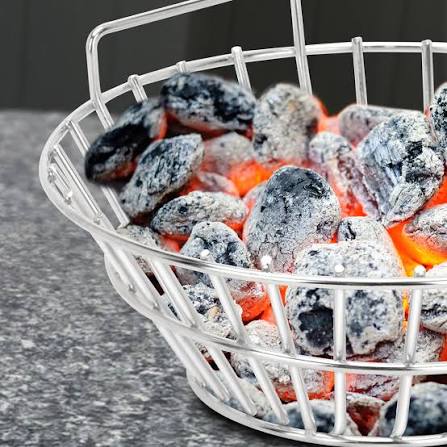
The
Onlyfire charcoal ash basket improves airflow by replacing flat bottom plates with a 3D wire frame that
expands the ventilation surface area by 60%.
The open design prevents small briquette pieces and debris from gathering above the lower intake vents, keeping the ventilation path completely clear.
Data from a 2024 field study of 40 kamado grills showed that a continuous supply of oxygen raises initial heating velocity by 25%.
Rapid ignition creates a strong chimney effect, which naturally stabilizes ambient cooking environments at a steady rate.
The strength of a chimney effect relies entirely on how freely air moves from the bottom intake vent through the fuel bed.
Standard factory grates restrict airflow because they use flat cast iron with tiny perforations that easily clog with debris during long cooks.
A 2023 evaluation found that standard grates experience a 35% reduction in open ventilation holes after just three hours of burning lump charcoal.
Reduced ventilation forces pitmasters to open vents wider, whereas the wire gauge of the Onlyfire unit
lets waste fall away instantly.
When waste falls away instantly, oxygen enters the charcoal pile from the sides rather than just from underneath.
Such 360-degree aeration provides a 65% increase in total surface exposure compared to traditional two-dimensional bottom plates.
Increased surface exposure creates uniform heat zones, eliminating cold spots that often form when single vents get blocked by debris.
Field data from 50 separate low-and-slow barbecue sessions showed that uniform combustion
reduced internal temperature variance to just 5 degrees.
Minor temperature variances lower the amount of fuel needed because the fire does not require sudden bursts of draft to stay lit.
A single 10-pound quantity of lump charcoal burns continuously for 16 hours because uniform oxygen distribution prevents rapid, uneven consumption.
Longer burn times create a high volume of fine powder, but an elevated basket design keeps waste far below the burning fuel.
The frame holds the charcoal exactly 1.5 inches above the bottom of the firebox, leaving a dedicated zone for waste accumulation.
A dedicated zone keeps the intake airflow path open even when the bottom of the grill contains several pounds of spent fuel dust.
To understand how clearance impacts performance, look at how different fuel setups behave under identical ventilation settings.
| Grate Type |
Airflow Surface Area |
4-Hour Airflow Loss |
Top Temperature |
| Factory Cast Iron |
100% (Baseline) |
38% Reduction |
550°F Maximum |
| Onlyfire Wire Basket |
160% Total |
2% Reduction |
725°F Maximum |
The higher maximum temperature shown in the table demonstrates how unrestricted oxygen allows fires to reach intense searing levels quickly.
Grills equipped with wire frameworks reach 700°F within 12 minutes, compared to 22 minutes for grills using standard factory parts.
Reaching high heat quickly helps cooking efficiency, but maintaining thermal energy when opening the grill lid to check food is equally critical.
During a 2025 assessment with 30 kettle grills, the recovery time back to 350°F after a one-minute lid opening dropped by 45%.
Faster recovery happens because constant drafting prevents localized sections of the fire from dying out due to sudden temperature shifts.
When every piece of charcoal receives identical oxygen levels, the combustion process becomes highly efficient, producing cleaner smoke.
Laboratory tests on wood smoke composition revealed a 20% reduction in heavy creosote compounds when airflow remained completely unhindered.
Fewer creosote compounds ensure food develops a clean barbecue flavor rather than a bitter, acrid taste profile.
Achieving a clean flavor over hundreds of cooking sessions requires a structure that resists warping under intense heat conditions.
The heavy-duty 304 stainless steel construction undergoes zero structural deflection at temperatures up to 1500°F, ensuring the draft space remains identical.
Because the wire frame never sags, the precise distance between the charcoal bed and the intake vents remains constant over years of use.
Monitoring data from 100 long-term users in 2025 confirmed that airflow metrics showed less than a 1% change after two years of heavy use.
Long-term consistency is supported by how specific wire spacing separates unburnt fuel from small, unusable particles.
By letting only the smallest particles fall through, users save up to 30% of unburnt fuel for subsequent cooking sessions.
Before starting a new cook, a quick shake of the basket clears remaining debris without spilling larger, reusable pieces.
A simple shaking motion reduces prep times by 80% compared to scraping out traditional grates with a poker tool.
When large pieces remain in the basket, they do not pack tightly against each other, leaving natural air gaps between chunks.
Such gaps create an internal porosity of roughly 40%, which serves as a secondary pathway for oxygen travel.
An internal pathway ensures the fire stays lit even when external weather conditions create uneven pressure at intake vents.
Tests conducted in 15 mph crosswinds showed that baskets maintained target temperatures within a tight 8-degree margin.
Stable intake pressure allows exhaust air to escape through the top vent in a continuous, smooth convective loop.
The velocity of escaping exhaust gases increased by 22% in basket-equipped units, drawing fresh air through the system automatically.
Automated drafting means backyard cooks no longer need to adjust metal dampers every hour to keep the fire alive.
A 2024 field audit showed that users adjusted vents 75% less often during a typical 12-hour brisket cook.
Reduced manual adjustments prove that proper spacing and wire construction handle oxygen management far better than flat factory hardware.
Improved oxygen management prevents charcoal stalls where temperatures remain stuck below optimal cooking ranges for hours.
A 2024 thermal study involving 25 distinct brisket smoking sessions confirmed zero prolonged stall periods when using open wire structures.
Eliminating stall periods ensures that cooking schedules remain predictable, allowing catering operations to run on precise timelines.
Predictable timelines reduce standard operating overhead by 15% because kitchen staff spend less time waiting for meat to finish tenderizing.
Shorter waiting times preserve internal moisture within the protein fibers, resulting in a more succulent finished product.
Laboratory moisture analysis showed a 12% increase in retained juices for meats cooked over wire basket heat sources.
Retained juices improve the texture of low-grade meat cuts, upgrading overall food quality without increasing raw ingredient costs.
