
Reading Reference Projects When You Shortlist a Refillable Perfume Supplier
Reference projects are the easiest part of a supplier pitch to dress up, which is exactly why they deserve the hardest questions. What you want to know is not which logos appear on the slide but which parts of each project the supplier actually controlled, how the refillable pack behaved after repeated use, and what the project got wrong the first time. A supplier that can answer at that level is giving you something a logo wall never can: evidence of how it works when a project stops going to plan.
Key takeaways
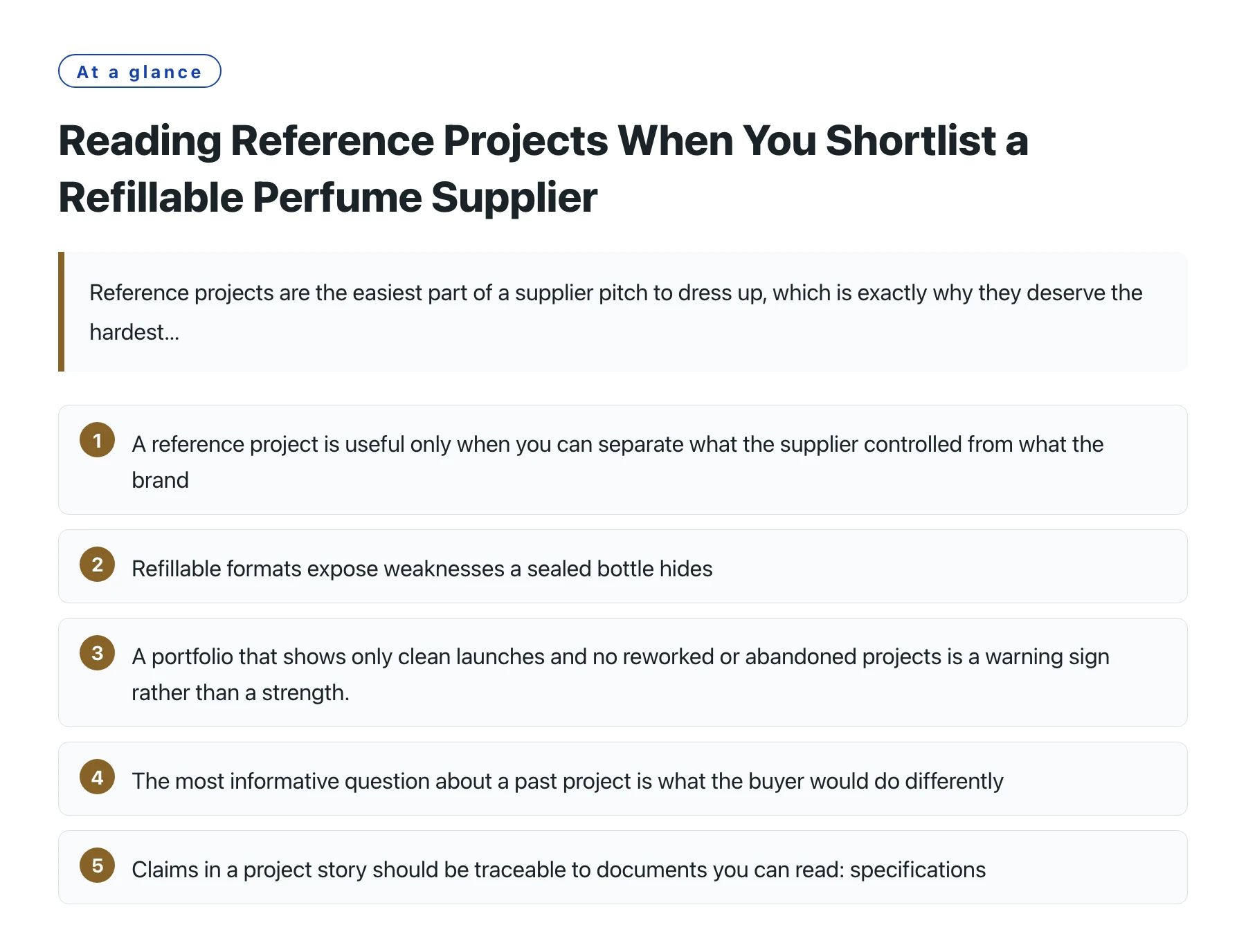
- A reference project is useful only when you can separate what the supplier controlled from what the brand, the bottle supplier or a design agency delivered.
- Refillable formats expose weaknesses a sealed bottle hides, including closure wear, refill transfer and how the pack behaves after many open-close cycles.
- A portfolio that shows only clean launches and no reworked or abandoned projects is a warning sign rather than a strength.
- The most informative question about a past project is what the buyer would do differently, and what the supplier changed in its own process afterwards.
- Claims in a project story should be traceable to documents you can read: specifications, test reports and the packaging bill of materials.
Every shortlist conversation reaches the same moment. The supplier opens a deck of past work, the pictures look good, and the meeting moves on before anyone has asked which decisions in those projects were the supplier's to make. That is a costly omission, because a portfolio tells you what was produced, not what will happen when your brief is the one being solved.
Refillable work makes the gap wider. A refillable perfume is a system of interacting parts, and a supplier can be excellent at the liquid while having little influence over the refill mechanism, the closure or the secondary pack. If the project you are being shown succeeded mainly because someone else owned the hard part, the reference says less about your outcome than it appears to.
What a project story claims, and what actually verifies it
| Claim in the pitch | What it often means | What to ask for |
|---|---|---|
| We developed this scent | The supplier matched a brief to an existing accord, or adjusted one | The development record: brief, directions sampled, revision rounds and the approved formula reference |
| We filled this refillable pack | The supplier filled a pack it did not choose or qualify | Which components the supplier sourced, which it qualified, and who owns the component specification |
| This brand is our client | A single project, sometimes a single sample round, sometimes a co-packer arrangement | The scope of work for that brand and the categories the supplier was responsible for |
| The format passed testing | Testing happened, but the protocol and acceptance criteria are unknown | The test protocol, the acceptance limits and the report the brand accepted at sign-off |
| We can do the same for you | The supplier believes its capability transfers without knowing your constraints | Two or three questions it cannot answer yet, and how it proposes to close them |
| We have done many of these | Volume of similar work, not necessarily similar difficulty | A project that went badly, and what changed in the supplier's process as a result |
Read the table against the last pitch you sat through. The rows you could not have answered are the rows you never really checked.
A reference-check sequence that produces evidence rather than impressions
- Fix the question before the meetingDecide in advance what the reference has to prove, for example that the supplier has qualified a refill closure or handled a formula with a restricted material.
- Ask for the decision list, not the storyRequest the three or four decisions that shaped the project and who made each one. Suppliers that own their work answer this quickly.
- Follow the packaging trailEstablish which components were specified by the supplier, which came from the brand, and who holds the drawings and tolerances.
- Ask what the refill was tested againstRepeated opening and closing, storage after first use, leakage in transit and compatibility between the refill container and the concentrate.
- Request one uncomfortable exampleA project where the first sample missed, or a format that had to be changed after a pilot run. The answer reveals more than the highlight reel.
- Write down what you verifiedKeep a dated note of what you saw and what remained unverified. It becomes the basis for the next conversation and for the contract.
The refillable-specific warning signs
Nobody in the room has seen the refill in service
A refillable system is judged by its second and twentieth use, not its first. If the people presenting the project have never handled the pack after a month of use, they are describing a filling job rather than a packaging outcome. Ask who holds the wear data, and if the answer is the brand rather than the supplier, treat the refill part of the reference as unverified.
Packaging rules are tightening in a way that rewards this discipline. European rules on packaging and packaging waste place obligations on the whole pack, including refillable and reusable designs, and they are written around evidence rather than intent [2]. A supplier that can already talk about refill durability in test terms is working in the direction regulation is moving.
The same project appears in several suppliers' decks
This is common and not automatically dishonest. A brand may use several partners on one launch, and each can legitimately claim a piece. The problem is when every partner describes the same piece. Narrow the question to a specific step and see who can describe it from the inside: who ran the filling trial, who chased the closure tolerance, who signed the batch record.
When you walk through such custom fragrance case studies with a supplier, a useful test is to ask what it would not do again. Partners who held only a peripheral role tend to describe the project in outcomes; partners who held the centre describe it in process.
Every project is a first-of-its-kind triumph
Portfolios are usually curated, and curation removes exactly the information a buyer needs. A supplier that can show a project where a formula had to be reformulated after stability testing, or where a refill pack was replaced after a pilot, is demonstrating that it detects problems before the market does. That is a capability, and it should be asked about directly rather than inferred.
Material restrictions are the most common reason a late change is unavoidable, because the limits apply per material and per product category rather than to the formula as a whole [1]. A supplier that has handled a reformulation triggered by a restricted material has already rehearsed one of the harder conversations you may need to have.
Where the reference check should end
A reference project cannot substitute for a trial. Its job is to tell you which risks are worth testing in yours, and to identify who inside the supplier has solved something similar before. Once you know that, the next step is a scoped first project with defined acceptance criteria, not a longer tour of the portfolio.
If you are still comparing development routes, it helps to look at what a custom fragrance development partner commits to at each stage, because the stages you cannot name are the ones that will not be quoted.
Equally, if coordination across several vendors is what worries you, a a contract manufacturer for perfume brands that already runs development and filling in one place removes an entire category of handover. Xuelei is one example of that model, based in Guangzhou; the point is not the name but the question you take into the next meeting.
Before the next pitch, write down three things the reference has to prove. If the supplier cannot show evidence for one of them, the portfolio has answered a question you did not ask.
Sources
- IFRA Standards Library (International Fragrance Association) —— The IFRA Standards Library lists the restrictions the fragrance industry applies to individual fragrance ingredients, based on safety assessments; it is the reference point for compliant fragrance formulation.
- European Commission: Packaging Waste and the PPWR —— EU rules on packaging and packaging waste, including the Packaging and Packaging Waste Regulation requirements on recyclability and design.
Frequently asked questions
How many reference projects should I ask a fragrance supplier for?
Two or three, examined properly, beats a long list. Ask for projects that resemble yours in format and in product category, and be specific about which part of each project you want to discuss.
Is it acceptable to ask a supplier about a project that failed?
Yes, and it is one of the most useful questions available. A supplier that describes what went wrong and what changed internally is showing process control. A supplier that has no such example may simply not be tracking outcomes.
What should I check specifically for a refillable format?
Closure durability over repeated cycles, refill transfer without spillage, compatibility between the refill container and the concentrate, and the behaviour of the pack after first opening and long storage.
Can I rely on a reference project if the brand will not talk to me?
You can still use the project as a discussion topic, but treat the claim as unverified. Ask the supplier for the documents it generated, such as specifications and test reports, and be clear about which parts remain unconfirmed.
Does a large portfolio indicate a better supplier?
Not on its own. Volume shows throughput, not fit. The relevant question is whether the supplier has solved problems close to yours and can explain the decisions it made.
The workplace deserves the truth.
Join 84,000+ readers who get the weekly Unfiltered digest — first-person, anonymous, unedited.